
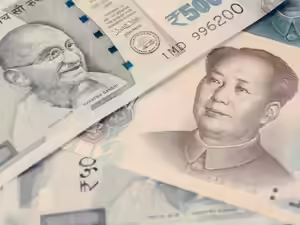
India’s flagship manufacturing drive, Make in India, is confronting an uncomfortable reality: China’s capital remains closely entwined with India’s industrial growth despite years of pushback and regulatory barriers. As New Delhi reconsiders long‑standing restrictions on foreign investment from neighbouring countries, Chinese money — directly or through indirect channels — continues to find pathways into India’s economy.
Since 2020, India’s foreign direct investment (FDI) policy has required government approvals for capital flows from countries that share a land border with India, a measure widely believed to specifically target Chinese firms. Known as Press Note 3, this rule aimed to guard against strategic or sensitive takeovers by restricting automatic entry for Chinese investors.
However, the Indian government is now examining ways to ease these constraints — particularly for small or low‑risk funds — by potentially introducing a de minimis threshold that would allow automatic approval for modest stakes. Officials say this would aim to streamline approvals and draw in capital without dismantling the broader safeguards of the policy.
Industry groups, especially in electronics and manufacturing, have urged New Delhi to adopt pragmatic measures such as permitting Chinese participation up to specified limits — for example, a 26 % equity cap in joint ventures — to attract investment, technology and integrate supply chains. They argue that such capital could deepen domestic manufacturing capacity rather than letting China’s dominance remain outside India’s production ecosystem.
Yet, regulatory hurdles persist at the operational level. Chinese electronics brands among India’s top consumer names — including Oppo, Vivo, Lenovo‑Motorola and Haier — are reportedly funding their Indian units through external commercial borrowing instead of direct FDI, owing to delays or non‑clearance under the current framework. Haier India, for example, has had an equity investment application worth around ₹1,000 crore pending with regulators.
Analysts say India is trapped in a “security‑growth trade‑off”: while geopolitical tensions with China persist, New Delhi must also ensure adequate capital and technology inflows to realise Make in India’s goals. The complexities of global supply chains — where Chinese dominance remains strong in components and intermediate goods — further complicate any blanket exclusion policy.
New Delhi’s approach reflects this balancing act. While Press Note 3 is unlikely to be completely rescinded, a calibrated opening through thresholds and clearer pathways for certain sectors may be on the table. Government sources emphasise that strategic guardrails will remain for large or sensitive investments.
Proponents of easing point to the vast scale of India’s manufacturing ambitions. They argue that allowing controlled Chinese investment could accelerate localisation of supply chains, create jobs, and better position India as a global export hub — outcomes central to the Make in India narrative. Critics, however, warn that easing too far could undermine domestic industry and pose long‑term security concerns.
As India navigates these choices, the debate underscores a broader shift in strategy: not outright exclusion, but selective engagement may define how Make in India reconciles lofty national goals with economic realities.
India ka flagship manufacturing program, Make in India, ab ek reality check face kar raha hai: China ka paisa ab bhi India ke industrial growth mein aata rehta hai, chahe government ne kaafi regulations aur restrictions lagaye ho. New Delhi ab ye soch raha hai ki kuch restrictions ko ease kiya jaaye, kyunki Chinese investments, direct ya indirect, ab bhi India ki economy mein aa rahe hain.
2020 ke baad, India ki FDI policy mein ek rule aaya — Press Note 3 — jisme border-sharing countries se investments ke liye government approval mandatory kar diya gaya. Ye rule basically Chinese firms ko target karta hai, taaki sensitive ya strategic acquisitions pe control ho.
Lekin ab government small aur low-risk funds ke liye rules ko thoda relax karne ki planning kar rahi hai. Ek de minimis threshold introduce karne ka plan hai, jisse chhoti investments automatic approval ke through India mein aa sakti hain. Isse capital bhi attract hoga aur overall policy safeguards bhi maintain rahenge.
Industry groups, specially electronics aur manufacturing sectors, suggest kar rahe hain ki Chinese participation ko 26% equity cap tak allow kiya jaaye. Isse India ka manufacturing capacity grow karega aur supply chains better integrate hongi.
Regulatory hurdles fir bhi hain. Chinese electronics brands jaise Oppo, Vivo, Lenovo-Motorola, aur Haier, apne Indian units ko fund kar rahe hain external commercial borrowing ke through, kyunki direct FDI approvals mein delays hain. Haier India ka equity investment application ₹1,000 crore ka pending hai.
Analysts kehte hain ki India “security-growth trade-off” face kar raha hai: China ke saath tensions ke beech, India ko capital aur technology bhi chahiye Make in India ke goals achieve karne ke liye.
New Delhi ka approach cautious hai. Press Note 3 ko completely hatana possible nahi, lekin thresholds aur sector-specific approvals ke through controlled opening ho sakta hai. Government ka kehna hai ki strategic guardrails large aur sensitive investments ke liye maintained rahenge.
Proponents kehte hain ki controlled Chinese investment se supply chains localize hongi, jobs create hongi aur India global export hub banega — jo Make in India ka main goal hai. Critics warn karte hain ki rules ko zyada relax karna domestic industry aur security ke liye risky ho sakta hai.
Ab India selective engagement strategy pe move kar raha hai, matlab sabko ban kar bahar rakhne ke bajaye, carefully engage karna Make in India ke liye realistic approach hai.