
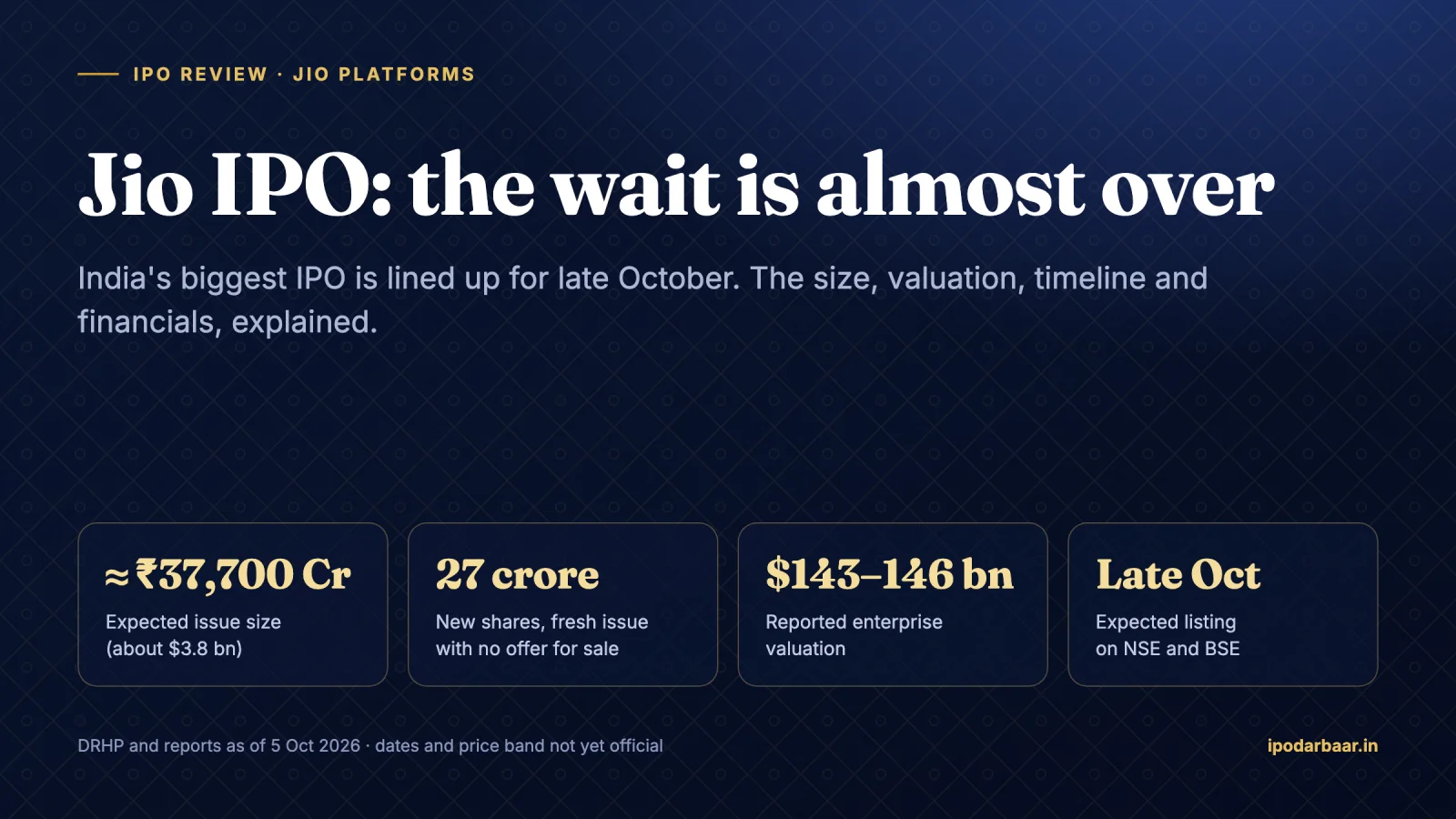
- Jio Platforms will issue up to 27 crore new shares, about 2.9% of the company; no existing shareholder is selling
- Bankers expect about $3.8 billion (roughly ₹37,700 crore), which would make it India's largest IPO
- The reported enterprise valuation is $143–146 billion, over ₹12 lakh crore
- ₹27,500 crore of the money will prepay borrowings of Reliance Jio Infocomm
- Expected: RHP in the week of 12 October, anchor book before Dussehra, public issue around 21–23 October, listing by month-end
- FY26 revenue was ₹1,46,885 crore and profit ₹30,049 crore; the price band and lot size are not out yet
In this post
- Jio IPO at a glance
- Expected dates: from DRHP to listing
- What Jio Platforms does
- Financials: three years of steady growth
- Where the money goes
- Who owns Jio, before and after the IPO
- How big is the Jio IPO?
- The valuation question
- Is there a quota for Reliance shareholders?
- What about the Jio IPO GMP?
- How to apply when the issue opens
- What to check in the RHP
- The bottom line
- Frequently asked questions
For years, "when is the Jio IPO coming?" was one of the most searched questions in Indian markets, and it never had a firm answer. Now it nearly does. Jio Platforms, the Reliance Industries company that owns India's largest telecom operator, received SEBI's final observations on its draft prospectus on 28 August 2026. It has finished its roadshows for overseas investors, and banking sources quoted by PTI expect the public issue to open in the second half of October, with listing before the month ends.
At an expected size of about $3.8 billion, the Jio IPO would be the largest in India's history. It would also be the first IPO from Reliance Industries in about two decades, since Reliance Petroleum listed in 2006.
This post brings together what is known so far: the issue structure, the expected dates, the valuation, three years of financials from the draft red herring prospectus (DRHP), and the points to check before you apply. Where a figure is still an estimate, we say so. The price band, lot size and final dates will be in the red herring prospectus (RHP), which is expected in the week of 12 October.
Jio IPO at a glance
| Detail | Jio Platforms IPO |
|---|---|
| Company | Jio Platforms Ltd, a subsidiary of Reliance Industries |
| Issue type | Book-built issue of fresh shares only, with no offer for sale |
| Shares offered | Up to 27 crore equity shares of ₹10 face value |
| Expected size | About $3.8 billion, or roughly ₹37,700 crore (bankers' estimate) |
| Reported valuation | Enterprise value of $143–146 billion, over ₹12 lakh crore |
| Stake offered | About 2.9% of the post-issue share capital |
| Use of the money | ₹27,500 crore to prepay borrowings of Reliance Jio Infocomm; the rest for general corporate purposes |
| Investor quotas | QIBs up to 50%, non-institutional investors at least 15% and retail investors at least 35% of the net issue, plus a reservation for Reliance Industries shareholders (size not yet disclosed) |
| Expected dates | Anchor book before 20 October; public issue around 21–23 October; listing by the end of October |
| Price band and lot size | Not announced yet |
| Registrar | KFin Technologies |
| Lead managers | 19 banks, including Kotak Mahindra Capital, Morgan Stanley, BofA Securities, Goldman Sachs, J.P. Morgan, Citigroup and Jefferies |
We will add a Jio Platforms IPO page, with live GMP, subscription figures and allotment status, as soon as the price band is announced. Until then, the upcoming IPO list and the IPO calendar show what is coming next.
Expected dates: from DRHP to listing
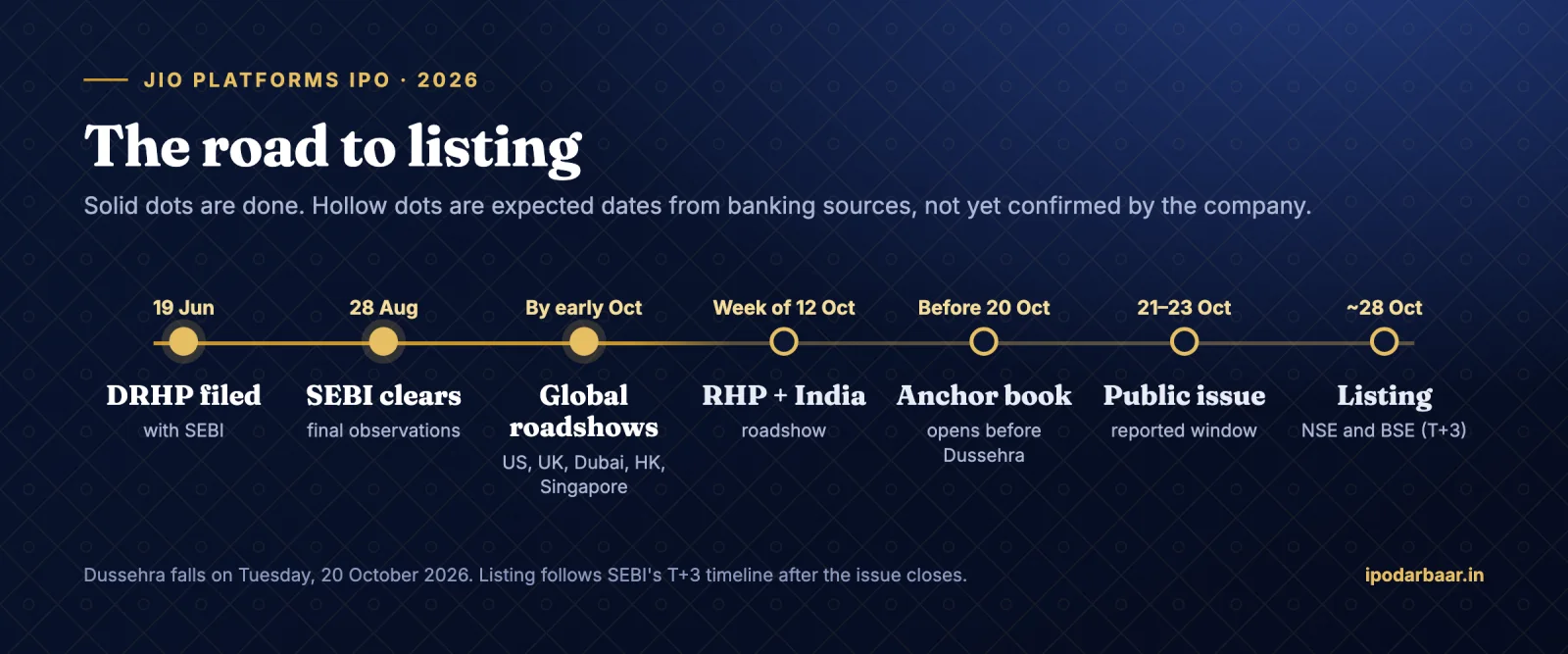
Jio Platforms filed its DRHP with SEBI on 19 June 2026, and SEBI issued its final observations on 28 August. Akash Ambani, Managing Director of Jio Platforms, and Isha Ambani, Executive Director of Reliance Retail Ventures, then led roadshows for global investors in the US, the UK, Dubai, Hong Kong and Singapore.
According to banking sources, the remaining steps are:
- Week of 12 October: the RHP is filed with SEBI and the stock exchanges, followed by a roadshow for Indian investors.
- Before Dussehra (Tuesday, 20 October): the anchor book. Large institutions bid for their share of the issue one working day before it opens to the public, and their shares are locked in for 30 to 90 days (see our anchor lock-in guide).
- After Dussehra, before 23 October: the public issue, with reports pointing to 21–23 October.
- By the end of October: listing on NSE and BSE.
If the issue does close on Friday, 23 October, SEBI's T+3 timeline would put the allotment on Monday, 26 October and the listing on Wednesday, 28 October. Treat these as working estimates. The price band must be announced at least two working days before the issue opens, and the RHP will carry the confirmed dates. If you are unsure what changes between the two documents, our DRHP vs RHP guide explains it.
What Jio Platforms does
Jio Platforms is the holding company for Reliance's telecom and digital businesses. Its largest subsidiary, Reliance Jio Infocomm, runs the Jio mobile network, which launched commercially in 2016 and is now India's largest telecom operator by subscribers. The group also sells home broadband through JioFiber and JioAirFiber, its fixed wireless service, along with enterprise connectivity and digital services.
| Operating metric (DRHP) | As of 31 March 2026 |
|---|---|
| Total subscribers | 52.4 crore (524.4 million) |
| 5G users | 26.8 crore, with 7.7 crore added in FY26 |
| Homes on JioAirFiber | Over 1.3 crore |
| ARPU (average revenue per user) | ₹214 a month in the last quarter of FY26, up from ₹206.2 a year earlier and ₹181.7 two years earlier |
| Data use per user | 42.3 GB a month |
| Monthly churn | 1.67% |
Two of these numbers matter most for investors. The first is ARPU. It rose by almost a fifth in two years, helped by the tariff increase of July 2024 and by users moving to 5G and larger data plans. Because most of a telecom network's cost is fixed once it is built, a large part of every extra rupee of ARPU turns into profit. The second is the size of the base. With more than 52 crore customers, Jio's growth now depends more on earning more from each user, and on newer businesses like home broadband and enterprise services, than on adding new mobile users.
Financials: three years of steady growth
| ₹ crore (consolidated) | FY24 | FY25 | FY26 |
|---|---|---|---|
| Revenue from operations | 1,09,558 | 1,28,218 | 1,46,885 |
| EBITDA | 54,959 | 64,170 | 76,255 |
| EBITDA margin | 50.2% | 50.0% | 51.9% |
| Profit after tax | 21,423 | 26,109 | 30,049 |
| Net profit margin | 19.6% | 20.4% | 20.5% |
| Net worth | 2,77,866 | 3,04,022 | 3,34,013 |
| Total borrowings | 54,349 | 73,060 | 70,781 |
| Total assets | 5,39,580 | 5,81,234 | 6,15,594 |
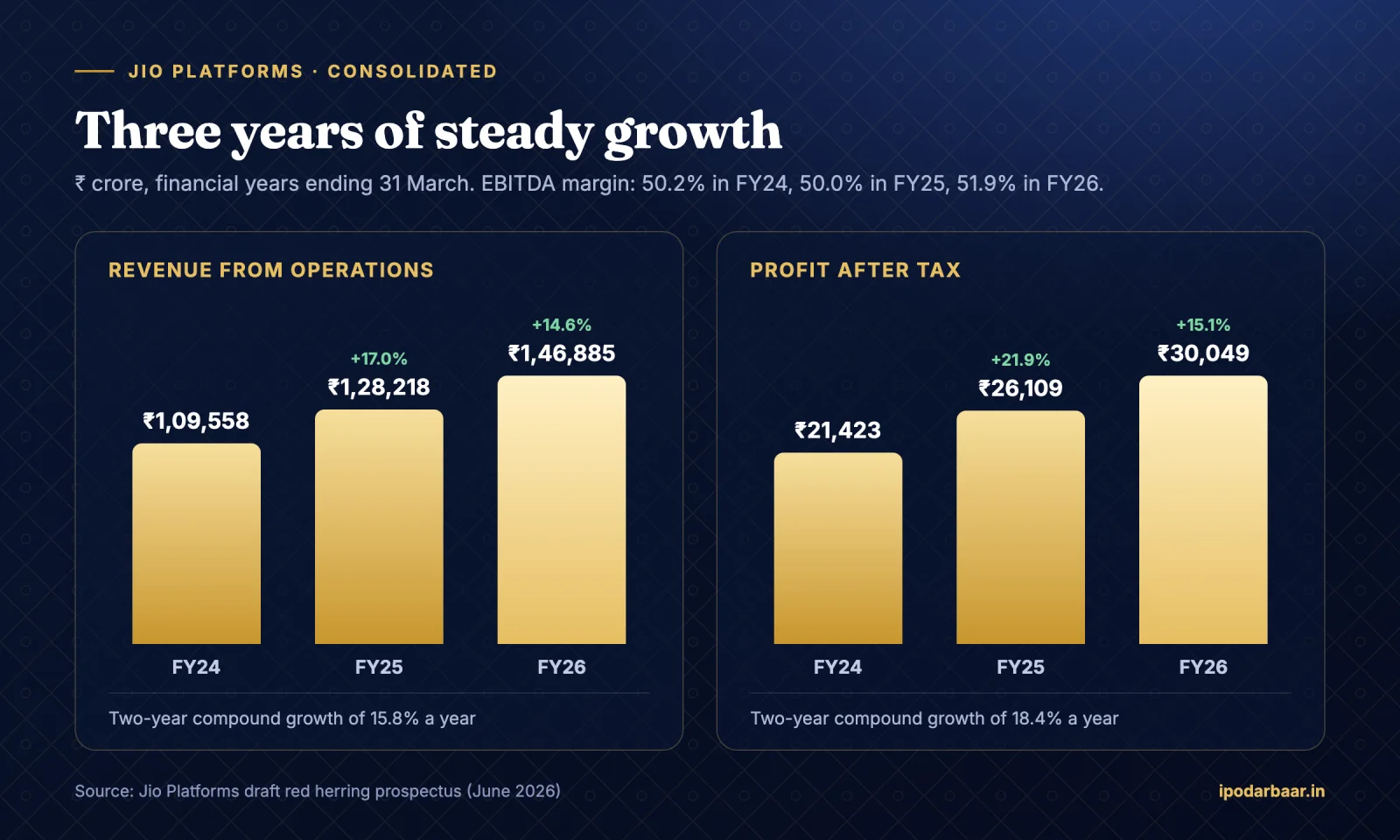
Revenue grew 17.0% in FY25 and 14.6% in FY26, a compound rate of 15.8% a year. Profit grew faster, at 18.4% a year, as the EBITDA margin edged up to 51.9%. A margin above 50% is high for a business of this size, and it reflects how much of a telecom company's cost is fixed: the towers, fibre and spectrum cost much the same whether 40 crore or 52 crore people use them.
The weaker number is the return on net worth, which the DRHP puts at about 9.4% for FY26. Jio's net worth of ₹3.34 lakh crore is large partly because it raised about ₹1.5 lakh crore in 2020 by selling stakes to Meta, Google and a group of global investors. That money built a large equity base, so even a ₹30,000 crore profit is a modest return on it. Borrowings, at 0.21 times net worth, are low for a telecom company.
Where the money goes
The whole of the Jio IPO is a fresh issue, so the money raised goes to the company. None of the existing shareholders, including Reliance Industries, Meta and Google, is selling. That is the opposite of India's two biggest IPOs so far, Hyundai Motor India in 2024 and NSE in 2026, which were entirely offers for sale: the money went to the shareholders who sold, not to the business.
Of the proceeds, ₹27,500 crore will repay or prepay borrowings of Reliance Jio Infocomm. That is about 39% of the ₹70,781 crore of consolidated borrowings at the end of FY26. The rest is for general corporate purposes, which SEBI caps at 25% of the money raised. On FY26 figures, repaying ₹27,500 crore and adding the new equity would bring borrowings down from 0.21 times net worth to roughly 0.12 times. Lower debt means lower interest costs, which should show up in profit from the first full year after the IPO.
Who owns Jio, before and after the IPO
| Shareholder | Before the IPO | After the IPO (approx.) |
|---|---|---|
| Reliance Industries | 66.43% | 64.5% |
| Meta (through Jaadhu Holdings) | 9.98% | 9.7% |
| 7.73% | 7.5% | |
| Other investors: PIF, KKR, Vista, Silver Lake, Mubadala, General Atlantic, ADIA, TPG and others | 15.86% | 15.4% |
| New shareholders from the IPO | – | 2.9% |
The number of shares rises from 893.9 crore to 920.9 crore. Because nobody sells, every existing holder is diluted by the same 2.9%, and Reliance Industries keeps close to two-thirds of the company.
Why is only 2.9% on offer?
SEBI's revised norms for very large companies allow a smaller first sale. A company worth more than ₹5 lakh crore after its IPO must offer shares worth at least ₹15,000 crore plus a small percentage of its value, and no less than 2.5% of its share capital. It then has five years to reach 15% public shareholding and ten years to reach 25%. Jio's 2.9% clears the minimum, but it also means more shares will have to be sold to the public in the coming years, which is worth keeping in mind as a source of future supply.
How big is the Jio IPO?
| IPO | Year | Issue size | Type |
|---|---|---|---|
| Jio Platforms (expected) | 2026 | About ₹37,700 crore | Fresh issue |
| Hyundai Motor India | 2024 | ₹27,870 crore | Offer for sale |
| NSE | 2026 | ₹22,562 crore | Offer for sale |
| LIC | 2022 | ₹21,008 crore | Offer for sale |
The Jio issue would be about a third bigger than Hyundai Motor India's, and at an enterprise value of more than ₹12 lakh crore, Jio would rank among the most valuable companies listed in India from its first day of trading.
The valuation question
Enterprise value is the value of a company's shares plus its net debt. At the reported ₹12 lakh crore or more, Jio would be valued at roughly 16 times its FY26 EBITDA of ₹76,255 crore. The price-to-earnings (P/E) ratio depends on the price band, so we will work it out on the IPO page once the band is announced.
The case for paying a premium rests on Jio's market position, margins above 50%, rising ARPU and room to grow in 5G, home broadband and enterprise services. The case for caution rests on the modest return on net worth, the heavy and recurring spending on spectrum and networks that telecom needs, and the fact that tariffs in India are set by competition between three private operators and watched closely by the regulator. When the RHP is out, compare its P/E and EV/EBITDA with those of listed peers such as Bharti Airtel before you decide.
Is there a quota for Reliance shareholders?
Yes. The DRHP includes a reservation for shareholders of Reliance Industries, but its size and the cut-off date for eligibility have not been disclosed. The RHP will set both. In past IPOs with a shareholder quota, eligibility has usually depended on holding the parent company's shares on the date the RHP is filed, and eligible shareholders could apply in the shareholder category as well as in the retail or HNI category.
Two cautions. Buying Reliance shares only to qualify for the quota is a separate investment decision with its own risk, and the quota does not guarantee an allotment if it is heavily oversubscribed. Wait for the RHP before acting on it.
What about the Jio IPO GMP?
Grey market quotes for Jio are already doing the rounds. Treat them with care: until the price band is known, a premium in rupees means little, and the grey market is unofficial and unregulated. Once the price band is out, we will track the Jio GMP on our live IPO GMP page.
How far can GMP be trusted? Our GMP accuracy tracker compares the last GMP before listing with the actual listing price of every IPO. For the 74 mainboard IPOs listed between January and early October 2026, the median gap was 4.9 percentage points, and the GMP called the direction (premium or discount) correctly 86.5% of the time. It is a useful signal, not a promise. Our guide to IPO GMP explains how it works.
How to apply when the issue opens
- Check the details. Note the price band, lot size and dates from the RHP or our IPO page.
- Apply through your broker or bank. Use your broker's app with a UPI mandate, or net banking (ASBA). Retail investors can bid up to ₹2 lakh. Bidding at the cut-off price means your bid still counts if the final price is set at the top of the band.
- Approve the UPI mandate in time. The money stays blocked in your account, not debited, until the allotment is final.
- Check the allotment. After the issue closes, check your status on the KFin Technologies site or our IPO allotment status page.
When the retail portion is oversubscribed, SEBI's rules aim to give as many applicants as possible one lot each, by lottery if needed. So applying for more lots does not raise your chances much in a heavily subscribed issue; applying from more family members' accounts, each with its own PAN, does. Our guides on how to apply for an IPO and how allotment works go through each step.
What to check in the RHP
- The price band, and the P/E and EV/EBITDA at the upper end of it.
- The size of the Reliance shareholder quota and the eligibility date.
- The lot size and the minimum investment.
- The anchor investors, and how much of the anchor book long-term funds take.
- The risk factors: competition, spectrum and licence costs, regulation, and dealings with other Reliance companies.
- Any plan for further share sales to reach 25% public shareholding.
The bottom line
The Jio IPO brings a very large and profitable business to the market, with a small float and a valuation that leaves less room for error. The fresh issue goes to cutting debt instead of paying out existing investors, which is a plus. The timeline points to a late-October launch, but nothing is final until the RHP is filed. Read the RHP, compare the valuation with listed peers, and apply only with money you can leave invested even if the listing is flat.
Frequently asked questions
When will the Jio IPO open?
Banking sources expect the public issue to open after Dussehra (20 October) and close by 23 October 2026, with listing by the end of October. The company has not announced the dates yet. They will be in the RHP, expected in the week of 12 October.
What is the Jio IPO price band?
It has not been announced. SEBI requires the price band to be announced at least two working days before the issue opens, so it should be out by the middle of the week before the issue.
How much will the Jio IPO raise?
The company will issue up to 27 crore new shares. Bankers estimate the issue at about $3.8 billion, or roughly ₹37,700 crore, which would make it India's largest IPO. The final amount depends on the price band.
Is anyone selling shares in the Jio IPO?
No. It is entirely a fresh issue. Reliance Industries, Meta, Google and the other investors are not selling, and ₹27,500 crore of the money goes to repaying debt at Reliance Jio Infocomm.
Can Reliance Industries shareholders apply in a separate quota?
The DRHP includes a shareholder reservation. Its size and the eligibility date will be set in the RHP. Check them before buying Reliance shares for this reason alone.
What is the Jio IPO GMP today?
Grey market quotes before the price band is known are guesswork. We will show the Jio GMP and how it changes each day on our live IPO GMP page once the price band is announced.
Should I apply for the Jio IPO?
We do not give investment advice. Jio is a large, profitable business with a strong market position, but the valuation is high and every IPO carries risk. Read the RHP, never put all your savings into one IPO, and speak to a SEBI-registered adviser if you are unsure.
Sources: Jio Platforms DRHP (June 2026), and reports quoting banking sources up to 5 October 2026. Post-issue holdings are our estimates from the share counts in the DRHP. This post is for information only and is not investment advice.
This review is for information and education only. It is not a recommendation to apply for, buy or sell any security. IPO Darbaar is not a SEBI-registered investment adviser. Grey market premium (GMP) is unofficial and can change quickly. Read the offer document (RHP) and consult a registered adviser before investing.