
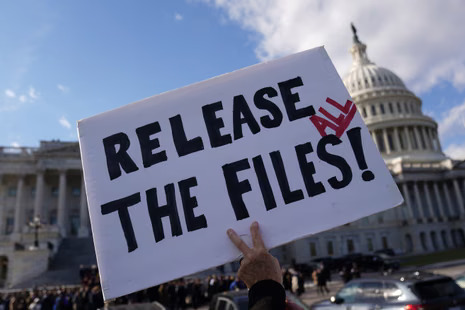
The U.S. Department of Justice has begun releasing documents related to its investigations into convicted sex offender Jeffrey Epstein, following a new federal transparency law. The release marks a long-awaited step toward public disclosure, but it has also triggered sharp criticism from lawmakers, victims’ advocates, and transparency groups due to extensive redactions and missing material.
Under the recently enacted Epstein Files Transparency Act, the Justice Department was required to publish all unclassified records connected to Epstein within a set deadline. While officials released hundreds of thousands of pages, the department acknowledged it has not yet completed the full disclosure.
Heavy Redactions Raise Concerns
The documents include photos, court filings, flight logs, and investigative records. However, many pages are heavily redacted, with some entirely blacked out. Critics argue the level of redaction undermines the law’s intent and limits meaningful public accountability.
Several released materials reference well-known public figures who had social or professional contact with Epstein in the past. Officials emphasized that the presence of names or images does not imply criminal wrongdoing, and no new charges were announced as part of the release.
Justice Department officials stated that redactions were necessary to protect victims’ identities and comply with privacy laws. More than 1,000 victims are believed to be connected to Epstein’s crimes.
Political and Public Backlash
Lawmakers from both major parties expressed frustration, accusing the department of failing to meet both the spirit and the letter of the law. Some members of Congress are now considering legal action or additional oversight to compel fuller disclosure.
Advocacy groups and survivors of Epstein’s abuse also voiced disappointment, arguing that partial transparency continues a long pattern of institutional secrecy surrounding Epstein’s network and enablers.
What Comes Next
The Justice Department says additional documents will be released in phases as review processes continue. Officials insist they remain committed to transparency while balancing legal and ethical obligations.
As public scrutiny intensifies, the Epstein files release is expected to remain a major political and legal issue, renewing questions about accountability, power, and the protection of victims.
U.S. Department of Justice ne ab Jeffrey Epstein ke against apni investigations ke documents release karna start kiya hai, naye federal transparency law ke under. Ye step long-awaited tha public disclosure ke liye, lekin lawmakers, victims’ advocates, aur transparency groups ne is par sharp criticism diya hai, kyunki kaafi pages heavily redacted hai aur abhi full disclosure complete nahi hua hai.
Epstein Files Transparency Act ke under, DOJ ko saare unclassified records ek set deadline ke andar release karne the. Officials ne hundreds of thousands of pages release kiye hain, lekin department ne maan liya hai ki abhi complete disclosure process baki hai.
Heavy Redactions ki Chinta
Released documents me photos, court filings, flight logs aur investigative records include hai. Lekin kaafi pages redacted hai aur kuch completely blacked out hai. Critics ka kehna hai ki itne heavy redactions law ka maksad undermine karte hai aur public scrutiny ko limit kar dete hai.
Kuch documents me well-known public figures ka zikr hai jo Epstein ke saath social ya professional contact me the. DOJ officials ne clarify kiya ki names ya images ka appear hona kisi tarah ka criminal wrongdoing imply nahi karta, aur release ke saath koi naye charges announce nahi kiye gaye.
Officials ka kehna hai ki redactions victims ki identities protect karne aur privacy laws follow karne ke liye zaroori the. Authorities estimate karte hai ki 1,000 se zyada victims Epstein ke crimes se connected hai.
Political aur Public Backlash
Donon major political parties ke lawmakers ne frustration express kiya, aur DOJ par accuse kiya ki woh law ke spirit aur letter dono meet nahi kar rahe. Kuch members of Congress legal action ya stricter oversight consider kar rahe hai taaki fuller disclosure compel ho sake.
Survivors aur advocacy groups bhi disappointed hai, kyunki partial transparency ek long-standing pattern of institutional secrecy ko continue kar raha hai, especially Epstein ke associates aur enablers ke around.
Aage Kya Hoga
DOJ ka kehna hai ki additional documents phased manner me release honge jaise-jaise review aur redaction process complete hota hai. Officials insist kar rahe hai ki transparency ke saath-saath legal, ethical aur privacy obligations bhi balance kiye ja rahe hai.
Jaise-jaise public scrutiny badh rahi hai, Epstein files ka release political aur legal issue ban ke rahega, aur accountability, power aur justice ke broader questions ko dobara highlight karega.
This news is for information only and is not investment advice. Please do your own research before making investment decisions.