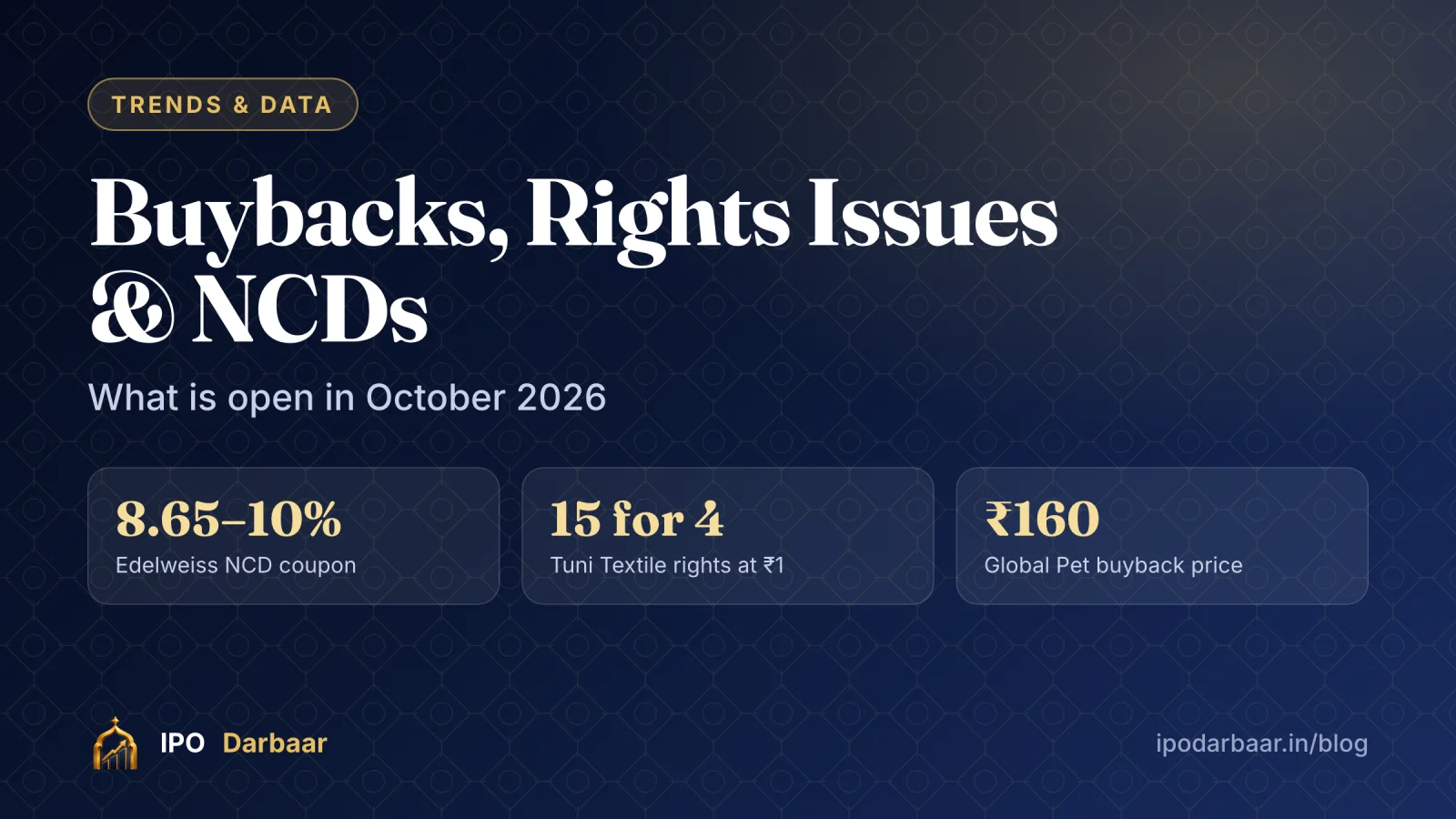
- Edelweiss Financial Services NCDs pay 8.65% to 10.00% a year and close on 5 October
- Tuni Textile Mills' rights issue (15 for every 4 held, at ₹1) is open until 26 October
- Global Pet Industries will buy back shares at ₹160 by tender offer; dates are awaited
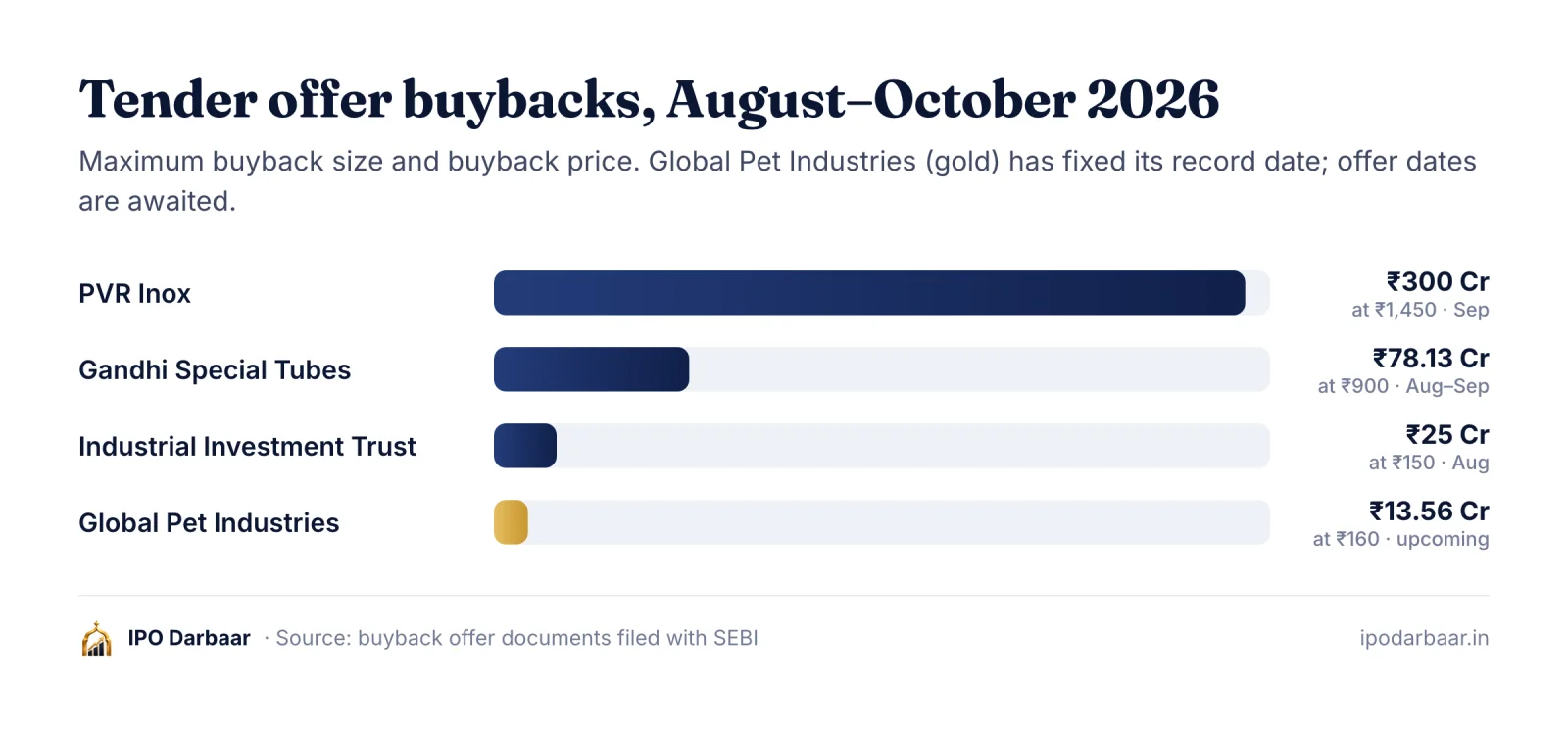
- PVR Inox, Gandhi Special Tubes and Industrial Investment Trust completed buybacks in August and September
In this post
IPOs get most of the attention, but listed companies also raise and return money through NCD issues, rights issues and share buybacks. These offers are easy to miss because they are open only for a short window and, for rights issues and buybacks, only to people who held shares on a record date.
This roundup covers the offers that are open now or coming up, and the ones that closed recently. The terms are taken from the offer documents filed with SEBI and the stock exchanges.
Buyback, rights issue or NCD: how they differ
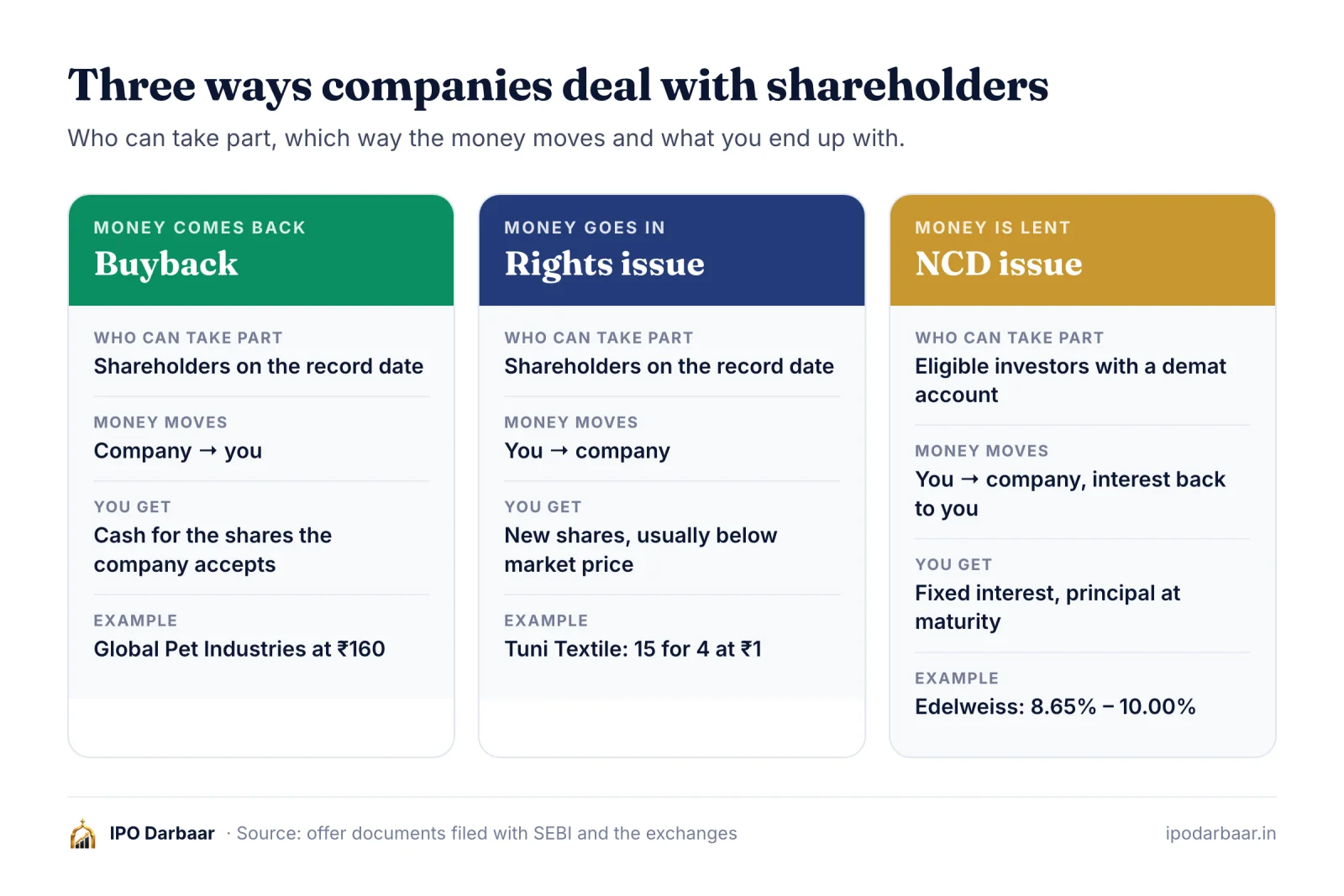
All three are offers from listed companies, but they work in opposite directions. In a buyback the company pays you; in a rights issue you pay the company for new shares; in an NCD issue you lend the company money and earn interest. Only a buyback and a rights issue are limited to people who already own the shares.
Open now
Edelweiss Financial Services NCD
| Detail | Edelweiss NCD |
|---|---|
| Issue size | Up to ₹300 crore (₹150 crore base + ₹150 crore green shoe) |
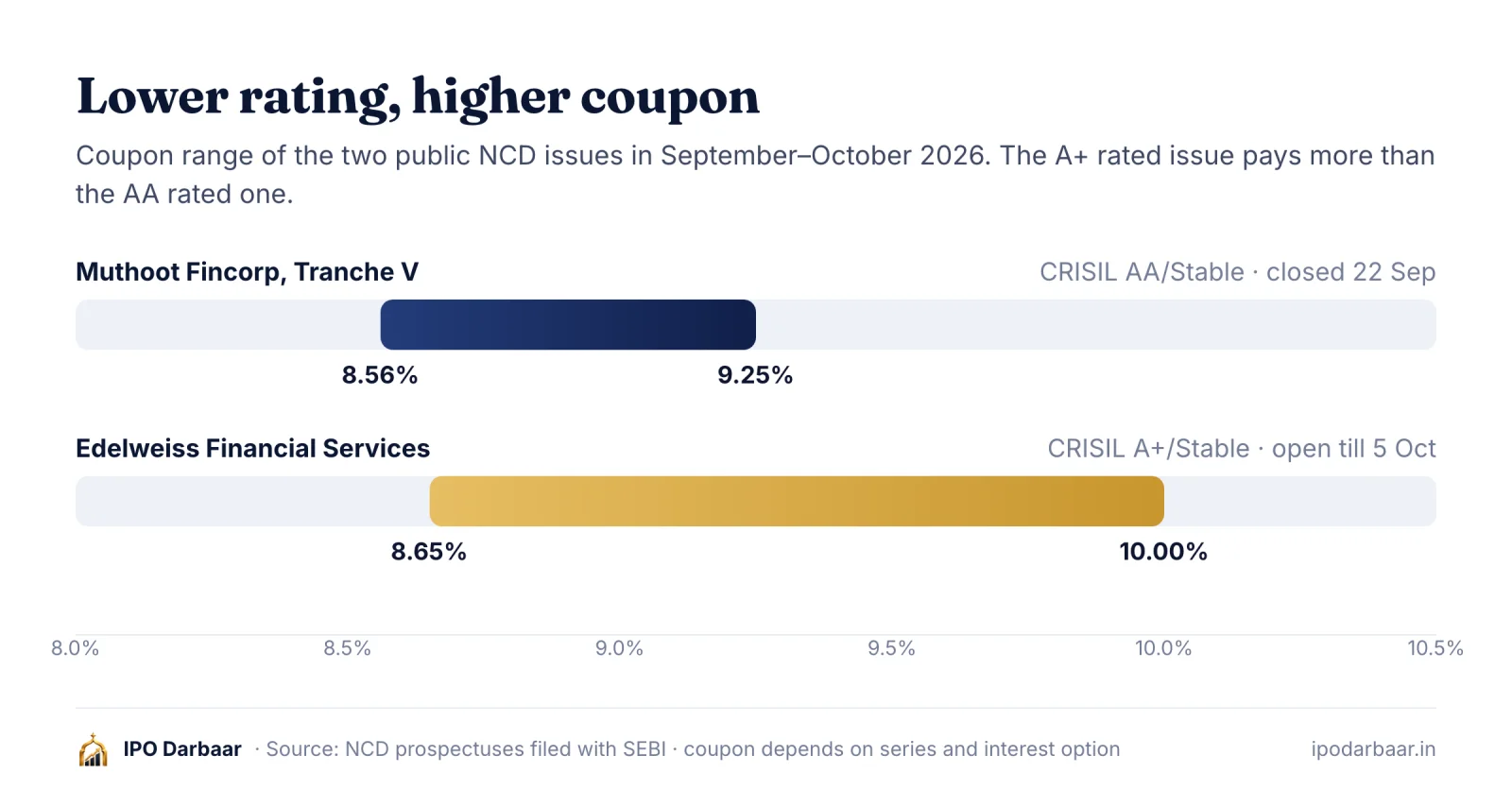
| Coupon | 8.65% to 10.00% a year, depending on the series |
| Tenure | 24, 36, 60 and 120 months |
| Interest options | Monthly, annual and cumulative (10 series) |
| Rating | CRISIL A+/Stable |
| Face value / minimum | ₹1,000 per NCD; minimum ₹10,000 (10 NCDs) |
| Dates | 21 September to 5 October 2026 |
| Listing | BSE |
These are secured, redeemable NCDs, so they are backed by a charge on the company's assets. Our Edelweiss NCD explainer covers the series, what the A+ rating means, tax and the main risks. Full details are on the Edelweiss NCD page.
Tuni Textile Mills rights issue
| Detail | Tuni Textile Mills rights issue |
|---|---|
| Ratio | 15 rights shares for every 4 shares held |
| Issue price | ₹1 per share (at par, face value ₹1) |
| Issue size | Up to 48,98,66,250 shares, or ₹48.99 crore |
| Record date | Wednesday, 16 September 2026 |
| Dates | 28 September to 26 October 2026 |
| Exchange | BSE |
At this ratio, a shareholder who held 400 shares on the record date can apply for 1,500 new shares, costing ₹1,500. Because the ratio is so large, the dilution for anyone who does not take part is heavy: every 4 existing shares become 19 once the issue is fully subscribed, so a non-subscriber's percentage holding falls to about 21% of what it was. Our rights issue explainer shows how to work this out for any issue. See the Tuni Textile Mills rights issue page for the details.
Coming up
Global Pet Industries buyback
Global Pet Industries, listed on NSE Emerge, will buy back up to 8,47,500 fully paid-up shares (7.19% of its paid-up equity capital) at ₹160 a share through the tender offer route, for up to ₹13.56 crore. Shareholders on the record date, Friday, 25 September 2026, are eligible. The promoter and promoter group have said they will not take part. The offer's opening and closing dates will be announced in the letter of offer; we will update the Global Pet Industries buyback page when they are out.
In a tender offer buyback, 15% of the shares being bought back are reserved for small shareholders, those whose holding was worth up to ₹2 lakh on the record date. How many of your shares the company actually accepts depends on how many other shareholders tender; the buyback acceptance ratio calculator helps you estimate it.
Keep tax in mind: since 1 October 2024, the money you receive in a buyback is taxed as dividend income at your slab rate, and the cost of the shares you tendered can be claimed as a capital loss.
How a tender offer buyback works
In a tender offer, the company announces a price, a maximum number of shares and a record date. Each eligible shareholder gets an entitlement: the number of shares the company promises to accept from them, worked out from their holding on the record date. You can tender more than your entitlement, and the extra shares are accepted only if other shareholders tender less than theirs.
Here is a simple example with round numbers. Say a company buys back 10,00,000 shares. 15% of them, or 1,50,000 shares, are reserved for small shareholders. If small shareholders tender 6,00,000 shares in total, the acceptance ratio is 1,50,000 ÷ 6,00,000 = 25%. A small shareholder who tenders 400 shares would have about 100 accepted at the buyback price, and the other 300 returned to their demat account.
Two details catch people out:
- Buy before the record date, not on it. Trades in India settle the next working day (T+1), so to be a shareholder on the record date you must buy by the trading day before it.
- The share price can fall after the offer. If the buyback price is well above the market price, the shares that are returned to you may be worth less once the offer closes. Work out the gain on the accepted shares and the possible loss on the rest together.
Closed recently
| Offer | Type | Terms | Dates |
|---|---|---|---|
| PVR Inox | Buyback (tender offer) | ₹1,450 a share, up to ₹300 Cr | 10 – 17 Sep 2026 |
| Gandhi Special Tubes | Buyback (tender offer) | ₹900 a share, up to ₹78.13 Cr | 27 Aug – 2 Sep 2026 |
| Industrial Investment Trust | Buyback (tender offer) | ₹150 a share, up to ₹25 Cr | 21 – 28 Aug 2026 |
| Muthoot Fincorp (Tranche V) | NCD | 8.56% – 9.25% a year, CRISIL AA/Stable, up to ₹700 Cr | 8 – 22 Sep 2026 |
| Jaykay Enterprises | Rights issue (partly paid) | 3 for every 19 held at ₹75, up to ₹154.29 Cr | 7 – 18 Sep 2026 |
The two NCD issues are a useful comparison. Muthoot Fincorp's Tranche V, rated AA, offered 8.56% to 9.25%, while Edelweiss, rated A+, offers 8.65% to 10.00%. A lower rating generally comes with a higher coupon, because investors want to be paid for the extra credit risk.
What to check before you apply
- NCDs: the credit rating and outlook, whether the NCDs are secured, the interest option (monthly, annual or cumulative), how easily you can sell them on the exchange before maturity, and tax on the interest.
- Rights issues: whether you held shares on the record date, the issue price compared with the market price, how much your stake is diluted if you do not subscribe, and the last date to sell your rights entitlements.
- Buybacks: the record date, the likely acceptance ratio, and the tax on the amount you receive.
All current offers are listed on our buyback, rights issue and NCD pages, which we update as new offer documents are filed.
Frequently asked questions
Is the money from a buyback taxable?
Yes. Since 1 October 2024, the amount you receive when the company buys back your shares is taxed as dividend income at your slab rate. The cost of the shares you tendered can be claimed as a capital loss and set off against capital gains.
Can I sell my rights entitlements?
Yes. Rights entitlements are credited to your demat account and can be sold on the stock exchange during the RE trading window, which ends a few days before the issue closes. Entitlements that are not used or sold lapse when the issue closes.
Are NCDs safer than bank fixed deposits?
Not in the same way. Bank deposits are insured by DICGC up to ₹5 lakh per depositor per bank; NCDs have no such insurance. Secured NCDs are backed by the company's assets, and the credit rating gives an opinion on safety, but the risk of delay or default stays with you.
Where can I see every open buyback, rights issue and NCD?
Our buyback, rights issue and NCD pages list current and recent offers with their dates, terms and links to the offer documents.
For information and education only; not investment advice. Figures come from offer documents, exchange and SEBI filings and IPO Darbaar data as of the date of publishing. Grey market premium (GMP) is unofficial.